Wednesday, November 18, 2015

Monday Wellness Reflection

11/16/15
Badminton- Monday Wellness Reflection


The topic that Jennifer and I chose our Monday Wellness was badminton. After weeks debating over what our topic should be from coffee to exercise videos to freezer meals, we finally decided on the idea of recreational sports. One sport that we both have in common is badminton, since we both play on the school badminton team. Jennifer plays varsity singles while I play varsity doubles and singles (depending on the slotting).
Badminton is a great form of exercise. During the season we play 2 hours a day and I train twice a week outside as well. It's an intense game due to all the running and sudden direction changes; it engages all your muscles when you have to propel yourself across the court in about 3 steps every direction. With all that movement, the respiratory system gets a great workout and increases in function to improve the exchange between carbon dioxide and oxygen in the lungs. However, the most interesting fact that I learned was that badminton burns 480 Calories per hour, which was a lot more than 398 from jogging. 
One other thing I learned was that badminton is the most played sport that is not an NCAA sport. Tons of people play badminton; it’s a lifelong sport that creates lifelong friends. A benefit to badminton is its social aspect. It requires more than one person to play, whether it be a singles opponent or a doubles team. Personally, when I switched over to doubles the most challenging part was communicating with my partner. You need to know who gets what shots and when, otherwise you end up colliding in the middle of a rallying by going for the same shot. My partner and I have to practice constantly in order to perfect that form of connection between partners, and we’ve become extremely close due to all the hours practice that we’ve been through together. But after you get the hang of understanding how the other moves and thinks, there is an extremely close bond between you and your partner because of the almost telepathic form of communication developed between the two of you.
A stereotype that surrounds badminton is the lack of physical exertion. However, I get the most tired from playing badminton compared to some of my other activities such as dance and marching band; within the first few minutes of footwork and warm up I am normally winded and perspiring. Badminton requires constant, high-energy movement throughout the entire game, since getting the point relies on how fast you can react to your opponent’s shots. It’s also mentally exhausting because you have to be laser- focused on your opponent: how they play, what shot they make, where to hit the bird to win the point. Each type of game requires a different technique and shot placement, which takes hours of practice to perfect. Now imagine that on top of sprinting around a court and the physical exertion of hitting the shots. Tiring, right?

Our topic was not just to show the benefits of badminton but rather the benefits to any sport that might be overlooked due to the “easy” nature of the game. While some recreational activities might seem easy, there is a lot of underlying skills and work that are necessary to be at least a decent player, which we hope we exposed during our presentation and class activity. We also hope that we disproved some myths about badminton and encouraged more people to try the sport. Getting everyone involved proved to be difficult; however, I think we did pretty well with providing the basics to keep everyone engaged. It seemed like everyone enjoyed the activity and getting to hit around with friends.

Thursday, November 12, 2015

Sheep Heart Dissection Lab

11/12/15
Sheep Heart Dissection Lab
Question 7, 10
Question 12

Questions 5

  1. The pericardium is a double membrane sac that secretes fluid to lubricate the heart, as it reduces friction as the heart expands and contracts. The visceral layer is part of the heart wall while the parietal layer attaches to the body.
  2. Arteries are much thicker than veins, which we observes as we cut through the pulmonary vein to get to the left atrium. The veins were marginally thinner, almost like paper, and much more elastic than the arteries which consisted of more smooth muscle. 
  3.  The auricle is hollow and is visible on the outside of the heart. It is an extension of the atrium, which allows the atrium to hold more blood/ increase the capacity.
  4. Externally, the ventricles are not visible at all on the outside of the heart. However, atria, on the other hand, have an extension called auricles, which are ear-like structures on the outside surface of the heart. Surrounding the left side of the heart, there is a thicker layer of myocardium because it requires more force to expel the blood to the entire lower half o the body than it does to push the blood to the lungs. 
  5. See picture above
  6. The anchoring of the heart valves by the chordate tendinae and the papillary muscle is important to heart function because without these, the valves would not be functional, causing a back flow of blood. The chordate tendinae and the papillary muscle are used to close the valve and without being anchored they wouldn't be able to flex and contract and close the valve.
  7. We see the inside of the left atrium, which a hollow cavity. Looking down, we can see the bicuspid valve, which is held to the walls by chordate tendinae and papillary muscles. see pic above
  8. The semilunar valves are utilized to prevent the back flow of arterial blood from re-entering the heart as the heart pushes blood out to the lungs and the rest of the body. The pulmonary semilunar valve helps stop any leakage of blood as it is pushed to the lungs while the aortic semilunar valve prevents back flow as blood is pumped to the rest of the body.  
  9. a) If there is a defect with the valves on the right side of the heart, the blood would leak back through the valves. Because the blood on the right side of the heart comes from the rest of the body, backflow and gravity would pull the blood back down to the feet and ankles, causing swelling.
    b) If the valve disease existed on the left side, one could expect to see problems with the oxygen exchange in the lungs, as the blood would backflow to the lungs. This would probably affect the rest of the body as well because the blood would not be quite as efficient at providing the rest of the body with oxygen.
  10. After we cut the heart into cross sections, we had a clear view of the left atrium to the left ventricle. The bicuspid valve is functional due to the chordate tendinae that hold the valve flaps. From the left ventricle, we found an opening to the aortic semilunar valve. Although we found this opening, it was mostly obscured from our view; however, it possessed a similar structure to the biscuspid. see pic above
  11. The left side of the heart contains a thicker myocardium layer due to the extra force need to the push the blood to the rest of the body, as the right side of the body only needs to push the blood to the lungs, a lesser distance in comparison. The right side contains deoxygenated blood from the rest of the body while left side contain oxygenated blood from the lungs. 
  12. see picture above

Wednesday, November 11, 2015

Unit 3 Reflection

11/11/15
Unit 3 Reflection
  Unit 3 was all about the circulatory system. It included the heart, cycle of blood through the heart, heart diseases, and a brief segment on the respiratory system. The cardiovascular system works flawlessly with a combination of the heart, vessels, and accessory organs such as the lungs, liver, and kidneys. Starting in the heart, blood comes in through the super/inferior vena cavas into the right atrium. It then flows through the tricuspid valve into the right ventricle, where it is pushed through the pulmonary semilunar value to the lungs. After going through the lungs, the blood returns through the pulmonary vein into the left atrium down to the left ventricle through the bicuspid (mitral) valve. From there it goes through the aortic semilunar valve, out through the aorta to the rest of the body.
  Cardiovascular health is the health of the heart and the blood vessels. To promote cardiovascular health, one can exercise, eat right, and monitor their blood pressure and cholesterol levels. In the case that maintain a healthy lifestyle is not met, one can develop problems such as atherosclerosis, which could lead to heart attacks or strokes due to the blood clots in the vessels.
  After this unit, I definitely am more informed about the circulatory system than I was before. I was surprised how much time we spent on the dysfunctions of the circulatory system because it never occurred to me how major the topic was. A little bit more time about the circulatory system functioning in there rest of the body might have added some helpful, additional information to the unit.
  This unit went a lot smoother than the last one. The content was easier to understand than the last unit because this included more rote memorization. I feel that my strengths lie in my ability to memorize and apply that information to problems, which became particularly helpful with all the terms this unit. One weakness I have is how quickly that knowledge is applied to certain problems. Especially on calculations, which haven't popped up, my speed decreases often leading to time issues. However, this has yet to become a problem during this course.
  My unit 2 health goals are still in progress, as they should be. I have been getting a tad bit more sleep due to the end of the band season, and I look forward to being able to start up my spring sport again. Also, I got through the first round of college applications, which has made the process a bit more relaxed than before. I hope that I will continue to improve on my sleep as well as my eating habits.
Our chalk diagram of the heart
Sheep's heart dissection


Taking a look into the sheep's right ventricle

Monday, October 26, 2015

Snacking

10/26/15
Snacking
  1. What was healthy about the snack you made?
    It consisted of apples, peanut butter, and almonds. Apples reduce cholesterol and contain important nutrients. Peanut butter contains healthy fats. Almonds are high in protein.
  2. How often to snack?
    Snack once or twice a day about 2-3 hours before a meal. By doing so, it will reduce your hunger and prevent you from overeating at your next meal. 
  3. What's in a healthy snack?
    A healthy snack consists of about 2 or 3 nutritious snacks. They contain ingredients that are beneficial to your health and lack the malicious ingredients such as saturated fats and high carbohydrates
  4. Snacks to stay away from?
    Snacks to stay away from include ones that are high in carbohydrates and unhealthy fats. 
  5. What did you dislike/like about the activity?
    I thought the activity was well organized and the snack tasted good and was healthy at the same time. However, apples are not in season quite yet so that was the only downside to the delicious, cute snacks we made.

Wednesday, October 14, 2015

Blood Pressure Lab

10/13/15
Blood Pressure Lab
Data Table:

Heart Rates

Test Subject 1
Test Subject 2
Average of all subjects
Pulse Rate (radial)
66
66
66
Pulse Rate (carotid)
72
80
76
Stethoscope
62
76
69
Average for Individual Subjects
66.6
74
70.3

Blood Pressure

Subject 1
Subject 2
Blood Pressure (test 1)
115/70
117/78
Blood Pressure (test 2)
115/70
120/80


Analysis Questions:
  1. Compare the systole to diastole
    The systole is the pressure when the first tapping or slamming sound is heard through the stethoscope. The diastole is the pressure when the sound disappears. The systole measurement is higher than the diastole measurement. This is because the systole measurement is when the blood pressure first returns while the diastole measurement is when the pulse dies out. Therefore, the systole number will always be higher than the diastole pressure.
  2. What equipment is used to measure heart rate? To measure blood pressure?
    To measure heart rate, we used a stethoscope and our index and middle fingers. To measure blood pressure we used a stethoscope and a blood pressure cuff, which is also known as a sphygmomanometer.
  3. Why is using your thumb to measure pulse not ideal?
    It is not ideal to use your thumb to measure pulse because there is actually another pulse in your thumb that could mess up the reading when you are the taking your pulse.
  4. In your own words, describe how to use a blood pressure cuff.
    First, put the cuff on above the crease of your elbow. Put the drum of the stethoscope on the inside of the elbow, above the crease. Now, pump up the cuff to around 160 mmHg and slowly begin to release the air, and thus the pressure, from the cuff. Listen for the re-entrance of the blood, which will be a loud heartbeat. Make note of the number, and continue to listen to the heartbeat until it fade. Again, take note the number at which the pulse faded away. The first number is the systolic blood pressure while the second is the diastolic blood pressure.
How to properly put on the blood pressure cuff


Wednesday, October 7, 2015

Unit 2 Reflection

10/7/15
Unit 2 Reflection

   Health is, according to the World Health Organization (WHO), "a state of complete physical mental, and social well-being and not merely the absence of ideas of infirmity". There are actually five pillars of health which few people know about: nutrition, sleep, stress, social, and exercise. 
   Some of the essential themes covered in this unit were what makes you healthy and the effect of each pillar of health on our lives. In this unit, I learned a lot of new information about myself and my body which I did not know. I gained more insight into the workings of my hormones such as leptin and insulin, which affect blood sugar levels and appetite. I also learned about the correct types of exercise (cardio, bone-strengthening, muscle- strengthening) and how my regimen matches up to the requirements of a healthy workout. Also, I realized how important sleep is due to its regenerative abilities and assistance in integrating memory and information. On the flip side, I saw how harmful stress is to the body. I still feel a little fuzzy on the stress pillar, partially because I happened to miss the lecture for a college presentation and got the notes from friends. The next unit I hope to improve on keeping track of the topic learned and the concepts and vocabulary that come with each section. 
   Based on the criteria for health (i.e. five pillars), I feel that people at Saratoga High are generally pretty health, as the majority of the school participates in some sort of sport, eat healthy, and socialize with classmates. However, our campus is lacking in the sleep and stress department, which I believe stems from the homework and rigor of the course at the high school. Although some would argue that it is the student's responsibility to plan ahead, most of the time it is unavoidable. Starting off the week on a Monday means homework from all 7 classes, more than half of which is due the next day and leaves little to no time to get a jump of Wednesday's work. Also, extracurriculars take time as well, which subtracts hours from our homework time. For me, I lose about an average of 2 hours of homework time each day to outside activities. To promote greater health, I suggest assigning homework with the consideration of the amount of time the students have that day to complete the work because sometimes two days is not as much time as it seems. 
  
  
My health goals

One day of my food tracking on SuperTracker
Collage about the 5 pillars of stress

Thursday, September 24, 2015

Health Power Hour Reading

Name of Book: Eat Move Sleep by Tom Rath
Name of Chapter: The Three Building Blocks: Forget Fad Diets, Forever; Make Inactivity Your Enemy; Sleep Longer to Get More Done
Thesis: Rath identifies the three key points of living a healthy lifestyle as food, activity, and sleep. 
Summary: This chapter talked about how to start on the process of being healthier. Rath talks about quality of the food over the quantity and how really the key to being healthy is to be active, not just exercising. He also introduces the topic of sleep and how less sleep actually decreases "well-being, productivity, health, and ability to think" (17). Those who get more rest tend to maximize their achievement, which is seen in the way they practice: in short, focused bursts that last no longer than 90 minutes. 
Name of Chapter: Big Changes Through Small Adjustments: Every Bite Is a Net Gain or Loss; Step Away From Your Chair; Sleep Makes or Breaks a Day
Thesis: Rath uses his three main topics (eat, activity, sleep) to show how to improve overall health with small changes to one's everyday routine.
Summary: With food, Rath discusses how there is only loss and gain while eating. Any sort of processed food or extra sugar is a loss, but it also turns that entire meal into a net loss. He also brings up an interesting point is stating, "the only way to make this a clear net gain was to order my salmon without the barbecue sauce"(21). This shows how you as a person have to put in the effort to conscientiously make this decision to make your meal a net gain rather than a loss. Next, Rath moves onto talk about how sitting increases risk of early death, obesity, and other health risks. He suggests walking or taking the stairs, which can increase your energy level 150-200%. Following the same pattern to his other chapter, he ends with sleep and shows how the amount of sleep you start off with affects you the rest of the week. 
Name of Chapter: One Good Choice at a Time: What Counts More Than Calories; Use Product Placement at Home; Work Faster While You Walk
Thesis: Rath demonstrates how actively making changes to one's lifestyle is beneficial. He shows this through his use of statistics and personal experiences.
Summary: Rath states that only 1% of the population actually take time to read past the "Total Calories" on the nutrition label. He suggests that you should make it a habit to have "a ration of one gram of carbs for every one gram of protein"(26) and to avoid anything with a ratio higher than 5:1 (chips/ cereal average 10:1). His next advice is product placement. Place healthier food option out on the counter tops and at eye-level in the pantry as they are the most likely items for you to grab. The easiest things to grab will be the first ones you reach for, so organize the rest of your kitchen cabinets accordingly. Along with food placement, Rath talks about how he built his work station into his treadmill and walks an extra 5-10 miles a day. 
Name of Chapter: Forming Better Habits: Sugar Is the Next Nicotine; Substitutes are a Nicotine Patch; Take Two Every Twenty
Thesis: In this chapter, Rath underscores the importance of movement throughout the day and argues that sugar is like a drug. 
Summary: Taking a very strong stance on sugar, Rath states, "Sugar is a toxin. It fuels diabetes, obesity, heart disease, and cancer"(31). We consume more than 150 pounds/person every year, which will soon cause sugar to kill more people than any type of illegal substance. It's impossible to stop altogether, so start by reducing the amount of added sugar you intake. This counts for sugar substitutes as well because they will only cause you to crave sugar later in the day. Rath then moves onto explain how you should try to take a 2 minute (walking) break every 20 minutes. 
Name of Chapter: Giving Your Immune System a Boost: Judge Food by the Color of Its Skin; A Vaccine for the Common Cold
Thesis: Focusing on the immune system, Rath provides picking produce and getting "good" sleep as two ways to defend against viruses.
Summary: When at the grocery store, Rath suggests to pick "produce with dark and vibrant colors" (36). Along with vaccines, studies have shown that a good night's sleep (7 hours or more) were less likely to develop a cold. But how do you know how much sleep you're actually getting? Again, it's quality of quantity. Technically you can be in bed for 9 hours and only get 5 hours of "good" sleep. 
Overview Questions:
This reading relates to what we have learned in class so far and even a little more than that. It covered the topics of exercise, diet, and sleep. Rath discusses topics such as choosing the correct produce, looking at the nutrition label, and exercising/ being active throughout the day, which are all themes and subjects that we touched on in class. 
Tom Rath is a reliable source, so the information in here is worth listening to. He has written five international bestseller in the past 10 years. He obtained degrees from the University of Michigan and the University of Pennsylvania. He works as a scientist at Gallup and is also a guest lecturer at University of Pennsylvania. 
Overall, I like what Rath had to say. He gave reasonable tips and changes that anyone could make to their everyday lifestyle without it being too much of a hassle. Suggestions like looking at the ratio of carbs to protein and getting up for two minutes every 20 were intriguing to learn, and I hope to apply them to my lifestyle as well. As shown by the tips and information provided by Rath, this book is more practical than theoretical. He states facts from scientific studies that further his arguments. While the book is directed to benefit individuals, I believe that overtime this book could have a lasting impact on society as a whole if everyone were to listen to some of Rath's tips. 

Tuesday, September 15, 2015

What is Health? Collage

9/15/15 
What is Health?
  Health, to me, is maintaining an overall balance in the body through food, exercise, sleep, and stress. There are five pillars of health (as shown in the illustration below): food, exercise, sleep, stress, and social. I believe that I am the strongest in the food, exercise, and social columns; however, my sleep and stress areas are the two places that I need to improve. In this unit, I would like to learn more about how each of these pillars contributes to our overall health and what we can do to be in the best shape we can be. 

Tuesday, September 8, 2015

Unit 1 Reflection

9/8/15
Unit 1 Reflection
   This unit was all about the relationship between the anatomy and physiology in the different levels of organization (molecules, cells, tissues, organs). This idea was aided by the information about the various types of macromolecules, their structure, and how their arrangement affects the behavior of the cell and its corresponding tissue. All of this fell under the overarching idea that function is directly related to structure. 
   In the process to answer all these questions, I learned a plethora of information. Starting from the beginning of the unit, I gained more information about the four different types of macromolecules: lipids, proteins, carbohydrates, and nucleic acids. I also got to learn about how to describe location on the human body such as the knee is proximal to the ankle. Moving into more detail, we went on to learn about the four different types of tissue: nervous, muscle, connective, and epithelial. Although the material was very straightforward, I still struggle with identifying images of cells, as it is hard to see the detail on photocopied images. As we move forward in the year, I hope to improve my test score as well as by ability to identify different tissue.
   Everything we learn in school, well not everything, applies to the real world and our other studies. One example of this is the section on macromolecules. While learning about them in Anatomy and Physiology, I was studying them in Biology AP as well. It also gave me a preview into the possibility of what it would look like to major in a life science. Also, the anatomical terms that we learned in the beginning of the unit now make it a lot easier to understand crime shows (don't judge). 
Ear cartilage from the tissue lab
Photo by: Cayla Zelanis
Nervous tissue from the tissue lab
Photo by: Cayla Zelanis
Cellulose from the carbohydrate lab
Photo by: Jennifer Poo

Monday, September 7, 2015

Tissue Lab Relate and Review

9/3/15
Tissue Lab Relate and Review
  This lab was all about the four different types of tissue: connective, epithelial, muscle, and nervous. 
  Connective tissue is the most abundant tissue in the body. It is made up of mostly the extracellular matrix and cells such as macrophages and mast cells. The function of connective tissue is to bind, support, and strengthen other body tissues. It can also store energy, start the immune response, acts as a transport system, and protects/insulates the internal organs. There are two types of connective tissues: loose and dense, a unique trait that differentiates it from other types of tissue. Epithelial tissues have a similar function to connective tissue in that it is meant to protect the body as it lines almost every surface of our bodies, inside and out. Epithelial tissue comes in multiple forms from squamous (flat) to cuboidal (cube) to columnar (columns). They can also be arranged in a single layer (simple), multiple layers (stratified), or in between the two (pseudostratified). Muscle, like epithelial tissue, comes in multiple forms: skeletal, cardiac, and smooth. Skeletal and cardiac muscle are striated while smooth muscle lack the striations and line hollow organs. Lastly, nervous tissue is made up of neurons and neuroglial cells. Neurons consist of dendrites, a cell body, and an axon, which all help transport electrical signals throughout the body's nervous system.
  Throughout this lab, I made many connections between the slides and the information we have been receiving in class from the readings and the lecture notes. The hands- on experience helped solidify the information presented to us in this class. One connection that I made was how much the structure of a tissue is related to its function. For example, cardiac tissue's structure contains gaps to allow the tissue to contract and expand which helps it pump blood throughout the body. Another is connective tissue, especially those in blood cells. The circular shape of the blood cell allows it to carry the maximum amount of oxygen to other parts of the body. By identifying either a cell's purpose or its shape, you can almost always deduce the missing information because of how related function and structure are. Also I realized how all the different types of tissue interact with each other. From bone tissue to skeletal muscle to neurons to skin, all the various types of tissues work together to form a fully functioning body. Without tissue, it would be impossible to exist and be the species that we are today.

Left: Human bone cell 400x magnification. Right: Blood smear 400x magnification


Monday, August 31, 2015

All About Nerve Cells

8/30/15

8/31/15
All About Nerve Cells

  What controls our body, actions, and thought? Of course, we answer, "the brain". Yet, how much do we know about the brain, specifically the cells that basically let us control our bodies. 
  Nerve cells are a type of cell known as neurons. Their cell bodies range from 4 microns wide to 100 microns wide (a micron is 1/1000 of a millimeter). They are located throughout the body and the brain. Just in the brain alone there are about 100 billion nerve cells, and some run over a meter long throughout the body.
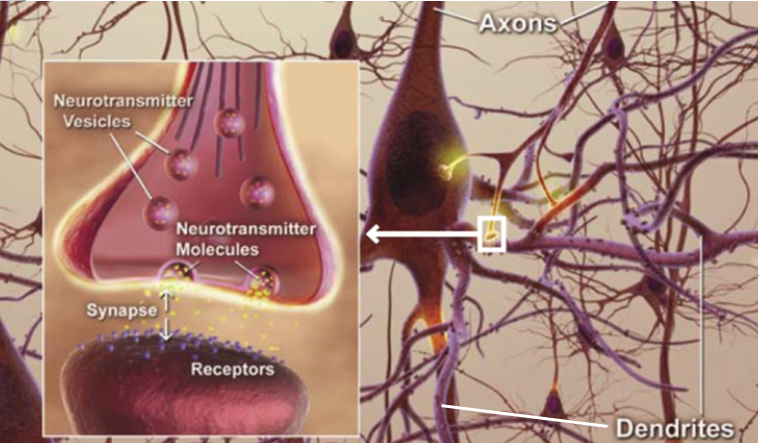
  There are three basic parts to the neuron: the cell body, the axon, and the dendrites. The cell body contains the nucleus as well as the basic organelles needed to function such as a nucleus, mitochondria, cytoplasm, and other organelles. The axon is like a cable that carries electrochemical messages. The dendrites are nerve ending at the end of a cell and connect with other cells to relay information/ signals. A myelin sheath, a fatty substance, covers the axon to protect the body from the electrical signals being sent.
  Neurons specialize in sending electrochemical signals throughout the body. A stimulus causes a signal to be transported from the cell membrane down to the axon, if the signal surpasses the action potential needed to start the reaction. This then causes potassium and sodium channels to open up as they being to carry the signal down the axon toward the terminal. The myelin sheath speeds up this process as well as stops the ions (K+ and Na+) from being exchanged with the outside environment. Once the signal reaches the end of the axon, the dendrites transfer the signal to the next cell membrane and the cycle continues.
  These cells function throughout the body to carry out these tasks and are classified as nerve tissue. Based on the direction and the type of information that is sent, nerve cells can be classified into different categories. Sensory neurons send information from the sense (nose, eyes, ears, mouth, skin) to the central nervous system. Motor neurons, for example, send signals from the central nervous systems to the muscles and glands. Interneurons send signals between sensory and motor neurons.

Please see pages for works cited.
  

Thursday, August 27, 2015

August 24, 2015
Sweetness Lab Response
    In this lab, we tasted different carbohydrates and ranked them in order of their "sweetness". Our goal was to determine how the carbohydrate's structure affected its sweetness. In the end, our group figured out that the monosaccharides and dissacharides were sweeter than the polysaccharides. We concluded that the longer the chain of monomers, the less sweet the sugar was.
    It is interesting how many ways these sugars appear in our everyday lives from food to our body processes (i.e. respiration). Foods such as milk, high fructose corn syrup, vegetables, fruits, and honey all include types of sugars like lactose in milk, fructose in corn syrup and honey, and even glucose and sucrose in fruits and vegetables.
    But then there is the question of how do we even taste sweetness? Can it even be quantified? Although we all taste sugar and sweetness differently, the way the tongue works helps explain how we taste sweetness. According to a informational video by the Smithsonian and an article from the U.S. National Library of Medicine, taste bud receptors do NOT single out individual tastes such as sour or salty, but rather they contain receivers for all 5 tastes. As humans, we tend to favor the salty, sweet, and umami (savory) foods instead of the bitter or sour ones. However, genetics play a factor as well as we each taste things differently than the person next to us, which, in the lab, explains the various numerical rankings that we gave.

The carbohydrates that we tasted. 
Photo by: Jennifer Poo